The problem
Tank shells need checking. Reaching them is the hard part.
The steel shells of crude, fuel, water and chemical storage tanks lose thickness to corrosion. Checking them today means people working at height, and that is the most dangerous part of the job.
Access costs more than the inspection
Scaffolding and rope access up a tank shell take time to set up, and someone still has to climb.
Assets go out of service
Tanks often sit idle while access is built and the checks are carried out.
Spot checks leave gaps
Manual readings cover only part of the surface, so thinning between points can be missed.
Safety impact
Send the robot up. Keep people on the ground.
UK Health and Safety Executive figures put them among the leading causes of fatal workplace injuries year after year. Every inspection done from the ground removes that exposure.
| Scaffolding / rope access | With KRWL | |
|---|---|---|
| People at height | Inspectors climb or hang from ropes for the whole survey | Nobody. The operator stays at the base |
| Setup | Scaffold erection or rope rigging, permits and rescue plan | Place the robot on the wall and start |
| Asset downtime | Often out of service while access is built | External surveys with far less disruption |
| Coverage | Spot readings at reachable points | Continuous readings along each lane |
| Records | Hand-written or typed up after the job | Readings shown live on the operator's screen |
Source: UK Health and Safety Executive (HSE) work-related fatality statistics.
In the field
From the drone's view to the tank wall
Fly in over a port tank terminal and down to KRWL mapping a shell course, while the pump and operator stay on the ground.
Illustrative render built from our CAD model. The port terminal is illustrative.
How it works
Cling. Crawl. Inspect.
KRWL handles the climbing; the operator watches the results come in from the ground.
Clamps to the steel
Magnetic wheels hold KRWL against flat ferrous steel, with no suction or tether needed for grip.
Drives the surface
The operator steers it across the wall from the ground, following a planned path over the area to survey.
Scans as it drives
A spring keeps the probe shoe pressed on the steel while KRWL drives lane by lane, measuring continuously with a 5 MHz ultrasonic probe. Water couplant flows under the shoe, fed through a 5 m tether from a pump on the ground. It moves into the next lane in a smooth S-curve, steering about 45°, without breaking the scan.
System architecture
What's inside, and how it connects
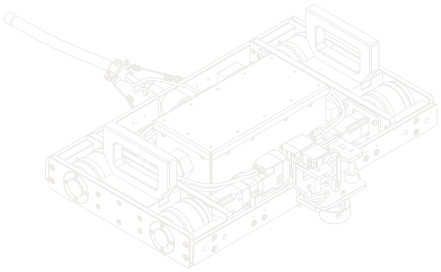
The main controller drives the wheels, moves the probe, reads each measurement and streams it to the operator over a wireless link.
Operator view
Every reading, mapped and graded
Designed to place readings on a map of the wall and grade them against nominal thickness, so problem areas stand out straight away. Position tracking is on the roadmap.
| Point | Position | Thickness | Status |
|---|---|---|---|
| A-01 | 0.40, 1.20 m | 9.8 mm | PASS |
| A-02 | 0.80, 1.20 m | 9.1 mm | PASS |
| C-09 | 1.80, 0.60 m | 8.2 mm | FLAG |
| D-11 | 2.20, 0.40 m | 6.9 mm | FAIL |
Illustrative data showing the interface. Not measurements from a real asset.
Specifications
KRWL at a glance
Product data of record. A figure in [ ] has not been measured yet; estimates are labelled as estimates.
Roadmap
Where KRWL goes next
The expo prototype proves the core idea. These are the steps from prototype to a field-ready inspection tool.
- Field trialsTesting on a real storage tank with an industry partner
- Position trackingWheel odometry and IMU to place every reading on the map
- Inspection reportsExport each survey as a report the client can file
- Weld and seam crossingReliable driving over welds and rivet lines
- Autonomous coveragePlans and drives the survey path by itself
- More sensorsAdditional NDT methods on one platform
- Hazardous-area ratingATEX / IECEx design for fuel and chemical sites
- Inspection as a serviceOffer tank surveys to terminals, refineries and tank farms
The team
INCEPT
FAQ
Questions we get asked
Something else on your mind? Ask us at the stand or leave your details below.
Which tanks can KRWL inspect?
Aboveground carbon-steel storage tanks: the steel shell of oil, fuel, water and chemical tanks. It cannot climb aluminium, most stainless-steel, concrete or fibreglass tanks, because they are not magnetic.
How does it stay on the wall?
Its wheels are magnetic, so the robot is pulled against the steel all the time without suction or power-hungry fans.
Does the tank have to be emptied or shut down?
Not for an external survey in most cases. KRWL works from the outside of the wall, so assets can often stay in service, depending on the site's own safety rules.
What happens if it loses grip?
In tests and demos the robot is used with safety measures in place around the test wall. A fall-arrest tether is standard practice for field use.
Is KRWL a product I can buy?
Not yet. It is a graduation project prototype. We are looking for sponsors and industry partners for field trials, so get in touch if you'd like to work with us.